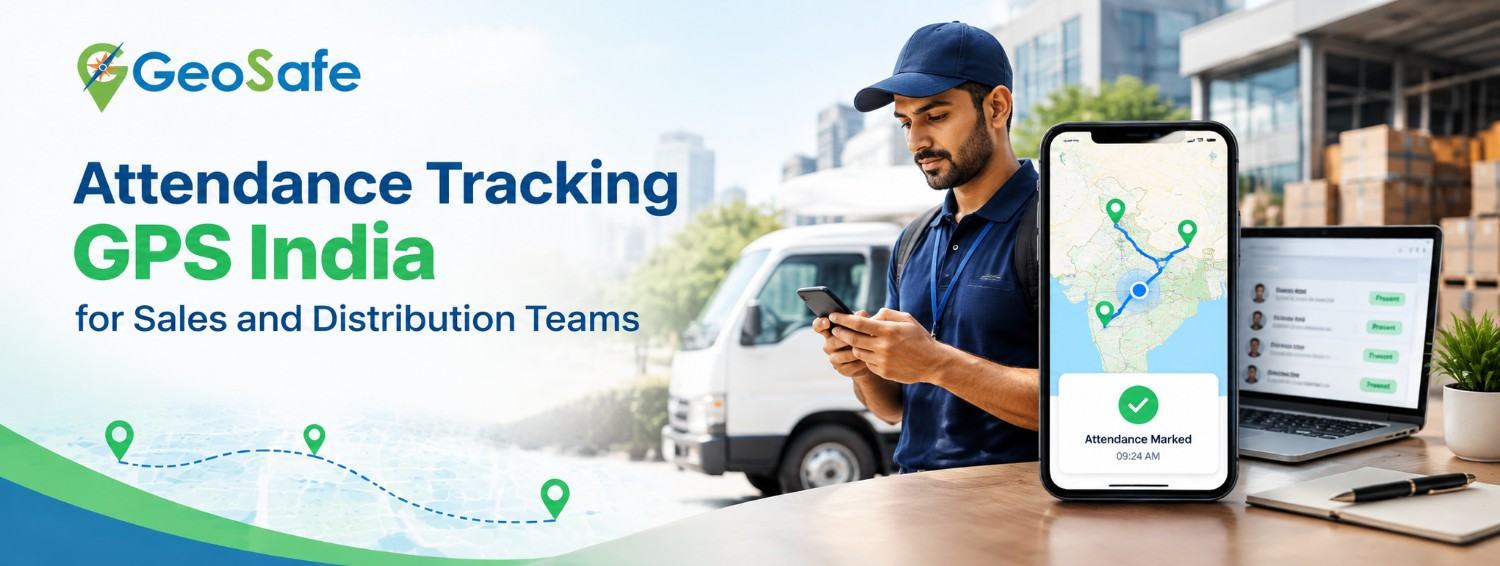
If you run a business with people constantly on the move, sales reps knocking on doors, distributors covering their territories, delivery guys racing against the clock, you already know that a regular attendance register doesn't tell you much. It tells you someone "logged in." It doesn't tell you where they actually spent their day.
That's the gap GeoSafe tries to close. The company builds GPS tracking, workforce monitoring, fleet management, route optimization, and IoT tools aimed at giving businesses real visibility into what's happening out in the field, not just who clocked in and out.
When companies go looking for GPS attendance tracking in India, what they usually want isn't a fancier punch-in system. Field teams don't sit at one desk, they hop between customers, distributors, retailers, warehouses, and drop-off points all day long, so the old office-style attendance model just doesn't fit. GPS-based attendance gives a far more honest picture of where people are, how they're moving, and what they're actually doing during working hours.
Why Sales and Distribution Teams Need Location-Based Attendance
Field work is a different animal from office work. A rep might spend six or seven hours a day away from any fixed location, moving through an assigned territory. A basic attendance sheet can't answer the questions that matter: Did they actually reach the area they were supposed to cover? Did the route make sense? Did the customer visit even happen?
GPS attendance fixes this by tying the attendance record to an actual location. Depending on how the system's set up, managers get access to live location updates, movement history, geofence alerts, and a broader view of field activity, all from one platform.
This tends to matter most for:
- Sales reps visiting retailers and customers
- Distribution staff juggling multiple territories
- Merchandisers checking stock at stores
- Delivery and service teams hopping between locations
- Supervisors trying to keep tabs on scattered field staff
- Companies with teams spread across a wide geography
How GPS Attendance Works for Field Employees
The exact setup varies by vendor and by what a business needs, but most systems follow a similar pattern.
the employee's location gets captured: This usually comes through an authorized phone or a connected tracking device, which tells the system where the person is during work hours.
that location gets tied to the attendance record: Instead of a bare timestamp, attendance now comes with context, where was this person when they checked in?
managers actually look at the data: Through a dashboard or app, supervisors can check whether someone's movement lines up with their assigned beat or schedule.
geofencing adds another layer: You can draw a virtual boundary around an office, warehouse, branch, or customer zone, and get notified when someone enters or exits it. Useful when reaching (or leaving) a specific spot actually matters to the workflow.
it all feeds into reports: All that raw location data eventually turns into something usable, attendance summaries, field activity breakdowns, route analysis, whatever the business needs to run more smoothly.
Key Benefits for Sales Teams
Real visibility, finally: Sales managers juggling reps across different territories often have no real sense of where anyone is at any given moment. GPS tracking hands them that context on a plate, something a paper register never could.
Attendance that means something: A timestamp alone tells you almost nothing. Pair it with a location, and suddenly attendance data has teeth. For companies looking into GPS attendance tracking in India, this matters even more when employees barely see the inside of an office.
Smarter territory management: Once you can see movement patterns, you start noticing things, which territories are overloaded, which areas are being neglected, where resources need to shift. That's hard to spot without location data.
Better-planned routes: Combine workforce tracking with route optimization, and daily visit planning gets a lot less chaotic. Past movement data also comes in handy when you're figuring out how to plan future routes more efficiently.
Benefits for Distribution and Delivery Operations
Distribution work adds another layer of complexity, movement here is tightly bound to delivery schedules, customer locations, and how efficient the route actually is.
Keeping tabs on scattered movement: When several distribution employees are out working different areas at once, having a clear view of where everyone is makes coordination a lot less painful.
Catching delays early: If a team is falling behind on its route, location data tells managers before a customer has to call and complain. That's the kind of context that lets you actually respond instead of just reacting.
Linking people to the bigger logistics picture: If a business is already running vehicle tracking or supply chain tech, workforce monitoring slots right in. Now you've got people, vehicles, routes, and deliveries all visible in one connected system instead of scattered across different tools.
Less paperwork, less hassle: Paper registers, phone-based check-ins, manually typed-up movement reports, all of that eats up time that could go somewhere more useful. A digital system just makes the information easier to pull up and review.
Important Features to Look for in a GPS Attendance Solution
Not every GPS attendance tool is built the same way, so it's worth being picky about what matches your team's actual working style, especially if you're comparing options for GPS attendance tracking in India.
Real-time tracking: Live location updates matter most when managers need to coordinate people during active work hours, not after the fact.
Location history: Being able to look back at where someone went during the day helps with both accountability and planning future routes.
Geofencing: Set up virtual boundaries around branches, warehouses, or customer zones, and get alerted the moment someone crosses in or out.
Works on mobile: Field ops don't happen at a desk, so managers need to be able to check tracking data from their phone, wherever they are.
Solid reporting: Good reports turn raw tracking data into something you can actually act on, attendance patterns, movement trends, problem spots worth a closer look.
Building a Connected Field Workforce
Field operations today need more than just attendance tracking. Sales teams need territory visibility, distribution teams need coordinated routes, and managers need information they can actually act on in real time.
GeoSafe brings real-time tracking, workforce monitoring, fleet visibility, route optimization, and supply chain tools together in one place. Connecting attendance, location, movement, and operations into a single system makes field management a lot more structured, and a lot less guesswork.
FAQs
1. What is GPS attendance tracking for field employees?
It's a system that records attendance alongside location data, giving a clearer picture of where field teams actually are during the day.
2. Does it work for distribution teams too?
Yes, distribution staff move constantly between warehouses, retailers, and delivery points, and GPS tracking helps managers coordinate that movement alongside logistics.
4. Can geofencing be added to GPS attendance?
Yes, if the platform supports it. Geofencing lets you set virtual boundaries and get alerts when someone enters or leaves a defined zone.
5. Does GPS attendance connect with fleet tracking?
Often, yes, depending on the platform. Combining the two gives a fuller view of people, vehicles, and routes together.
Conclusion
GPS-based attendance gives sales and distribution businesses a genuinely clearer way to manage teams who spend their days out in the field. Tie attendance to actual location, and you get better visibility, smarter territory planning, tighter coordination, and a lot less manual reporting to deal with.
The right move is picking a system that actually fits how your workforce operates, the right tracking depth, the right policies, and something that plays well with whatever tech you're already using. Done properly, location-based workforce monitoring stops being just an attendance tool and becomes part of how you run field operations better overall.
Want a clearer picture of your field team's attendance and movement? Talk to Our GPS Tracking Experts and figure out a tracking setup that actually fits your sales and distribution operations.